
Sooner or later every growing agency hits the same question. Clients want Google Ads and Meta ads, and someone has to run them. Do you hire a PPC specialist, or hand the work to a white label partner who delivers it under your brand?
Most articles on white label PPC vs in-house give you a vague list of pros and cons. This one shows the maths. Below we work out what an in-house PPC specialist really costs a US agency, using published salary and benefits data, explain how white label pricing works, give you a simple break-even formula, and cover the honest downsides of both options so you can decide for your own agency.
The Short Answer
For most small and mid-sized agencies, white label PPC is cheaper and faster until you have enough steady PPC work to keep a full-time specialist busy all year, plus someone senior to manage them. Once you pass that point, building an in-house team can make sense, and many agencies end up with a mix of both. The rest of this article shows you how to find where that point is for your agency.
What an In-House PPC Specialist Really Costs
The salary is only the starting point. Here is what a full-time PPC specialist costs once you add everything an employer actually pays for.
Salary
The average base salary for a PPC specialist in the United States is about $67,900 a year, based on salaries reported on Indeed. Experienced specialists and those in major cities cost considerably more, so treat this as a conservative starting figure.
Benefits and payroll taxes
According to the US Bureau of Labor Statistics, benefits make up 30% of total compensation for private industry workers, with wages making up the other 70%. That includes paid leave, health insurance, retirement contributions and legally required costs such as Social Security, Medicare and unemployment insurance. Applied to a $67,900 salary, benefits add roughly $29,100 a year, bringing total compensation to about $97,000.
Hiring costs
Recruiting is not free. SHRM benchmarking data puts the average cost per hire at nearly $4,700, covering job ads, recruiter time, interviews and onboarding. If the hire does not work out, you pay it again.
Tools
An in-house specialist needs software. A single seat on a research tool such as Semrush Pro costs $139.95 a month, or about $1,680 a year. Most teams also pay for reporting dashboards and call tracking, which we have left out to keep the estimate conservative.
Ramp-up time
Even a strong hire takes time to learn your clients, your processes and your reporting. For illustration, if a new specialist works at half speed for their first three months, that is about $12,100 of paid time that does not produce full output. Your own figure may be higher or lower, but it is rarely zero.
The total
| Cost item | Year one | Each year after |
|---|---|---|
| Base salary | $67,900 | $67,900 |
| Benefits and payroll taxes (BLS 30% share) | $29,100 | $29,100 |
| Hiring cost (SHRM average) | $4,700 | None |
| Tools (one Semrush Pro seat) | $1,700 | $1,700 |
| Ramp-up time (illustrative) | $12,100 | None |
| Total | About $115,500 | About $98,700 |
| Monthly equivalent | About $9,600 | About $8,200 |
Even this estimate leaves things out: management time spent hiring, training and checking work, equipment, cover when your specialist is sick or on vacation, and the cost of starting again if they leave. The real figure for most agencies is higher.
How White Label PPC Pricing Works
White label PPC is priced differently. Instead of a fixed salary, you usually pay per client account, either as a flat monthly fee, a percentage of ad spend, or a mix of the two. That changes the economics in three important ways.
- Your cost follows your revenue. You pay for the accounts you have, so a quiet month does not leave you paying a full salary with nothing to bill.
- There are no hiring, tool or ramp-up costs. The partner already has the team, the software and the processes in place.
- You get a team, not one person. Skills across Google Ads, Meta ads, tracking and landing pages, with cover built in.
Exact fees depend on the number of accounts, ad spend and platforms, so every quote is different. In our experience, agencies working with a white label partner save at least 50% compared with hiring an in-house PPC specialist, and many save far more. The best way to see your own numbers is to book a call for a quote based on your actual client accounts.
The Break-Even Point: When Does In-House Become Cheaper?
Because in-house costs are fixed and white label costs grow with each account, there is a point where hiring becomes the cheaper option. You can find yours with one simple formula:
Break-even accounts = your in-house monthly cost ÷ your white label quote per account per month
Using the ongoing figure above of about $8,200 a month, divide by the per-account quote you receive. If the answer is 12, you would need 12 steady PPC accounts every month before a full-time hire costs less than white label. Below that number, white label is cheaper. Above it, in-house starts to win on cost, as long as nothing else changes.
Then run a capacity check. The break-even only holds if one person can manage that many accounts well. If your break-even is 12 accounts but your specialist can realistically handle 10, you will need a second hire before you ever reach break-even, which doubles the fixed cost. Account complexity, reporting expectations and client communication all affect how many accounts one person can carry.
Finally, think about how stable your PPC work is. Break-even assumes you keep that number of accounts every month. If clients come and go, the months below break-even cost you money with an in-house team, while a white label partner simply scales down with you.
White Label PPC vs In-House: Side by Side
| Factor | White label PPC | In-house PPC |
|---|---|---|
| Cost structure | Per account, scales with clients | Fixed salary and overheads |
| Time to start | Days | Weeks to months of hiring and ramp-up |
| Skills | A team covering Google, Meta and tracking | Limited to one person’s strengths |
| Scaling up or down | Add or remove accounts easily | Hire or let people go |
| Direct control | Through your partner | Full, day to day |
| If someone leaves | Partner covers it | Accounts stall until you rehire |
| Management time | Low | High |
The Honest Downsides of White Label PPC
White label is not perfect, and any partner who says otherwise is not being straight with you. Here are the real trade-offs and how to reduce them.
Less direct control
You cannot walk over to a desk and ask for a change. Reduce this by keeping ad accounts in your or your client’s ownership, agreeing response times up front, and asking for a clear log of the changes made each month.
Communication lag
Requests pass through one more step before the work gets done. A named point of contact, a shared channel and a fixed weekly or monthly check-in keep things moving. Agree in advance how urgent requests are handled.
Quality varies between providers
Some white label providers are excellent and some are not. The fix is careful selection. Our guide on how to choose a white label PPC partner covers the 10 questions to ask and the red flags to avoid.
Less knowledge built inside your agency
With white label, the hands-on expertise sits with your partner. If you want PPC knowledge in-house over time, ask your partner to explain their decisions in reports and calls so your team learns as the work happens.
Relying on one provider
If your partner raises its prices or lets quality slip, every account it runs is exposed. Protect yourself by keeping account ownership, documenting each client’s setup, goals and history, and avoiding long lock-in contracts, so you can move to another provider or bring the work in-house without losing ground.
When In-House Is the Better Choice
In-house PPC makes sense when most of these are true:
- You have more steady PPC accounts than your break-even number, month after month.
- PPC is a core service you want to own and grow long term.
- You have someone senior who can hire, train and check a specialist’s work.
- You can carry the full first-year cost, including the months before a new hire is fully productive.
If only one or two of these apply, white label or a hybrid setup is usually the safer route.
The Hybrid Option
Many agencies do not choose one or the other. A common approach is to keep a PPC strategist or account manager in-house to own client relationships and strategy, while a white label partner handles the campaign building, optimization and reporting. Another is to start with white label, grow your PPC client base without fixed costs, and hire in-house once your account numbers are well past break-even. Either way, you get room to grow without betting a full salary on future sales.
Should Agencies Outsource PPC? A Quick Decision Guide
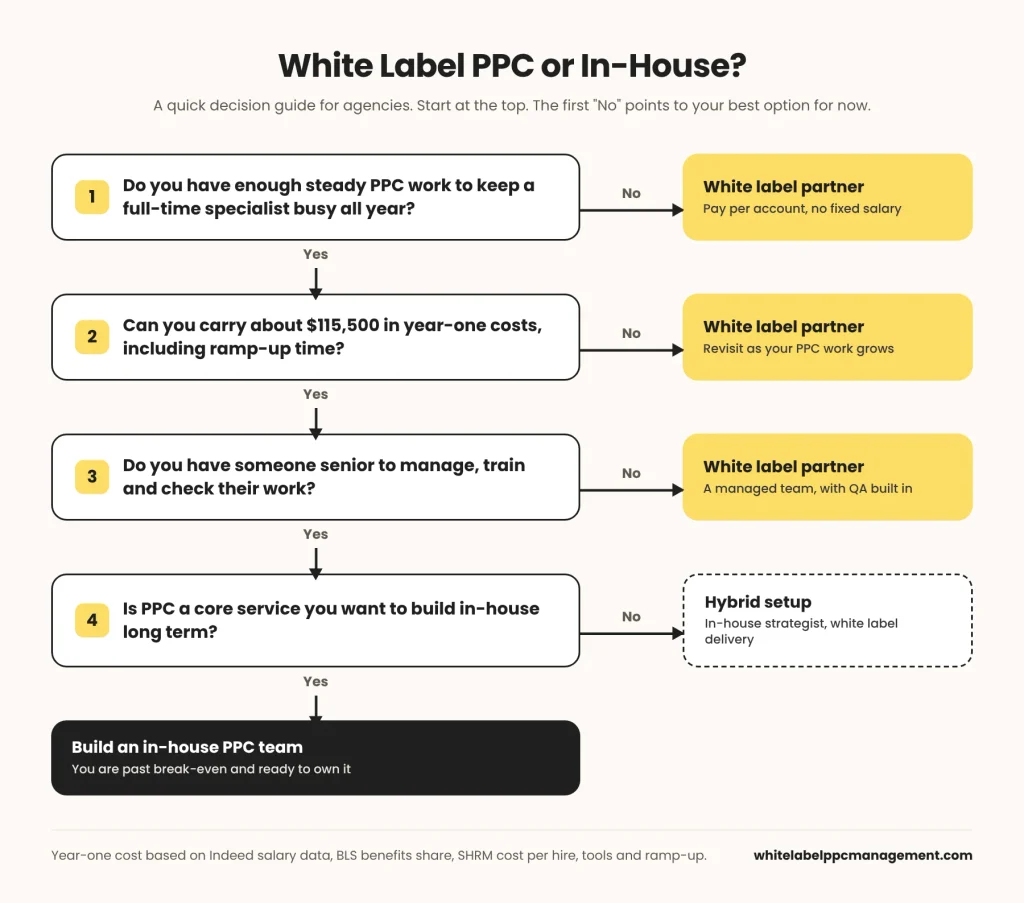
Work through these questions in order. The first “no” points you to the best option for now.
- Do you have enough steady PPC work to keep a full-time specialist busy all year? If no, use a white label partner.
- Can you carry about $115,500 in year-one costs, including ramp-up time? If no, use a white label partner and revisit as you grow.
- Do you have someone senior to manage, train and check their work? If no, use a white label partner.
- Is PPC a core service you want to build in-house long term? If no, consider a hybrid setup. If yes, building an in-house team makes sense.
Frequently Asked Questions
Is white label PPC cheaper than hiring in-house?
For most agencies, yes, until they have enough steady PPC accounts to pass their break-even point. A full-time US PPC specialist costs roughly $98,700 a year once salary, benefits and tools are included, before any management time. White label costs follow your number of accounts, so you only pay for the work you have.
How many clients do I need before hiring an in-house PPC specialist?
Divide your in-house monthly cost by your white label quote per account. The result is your break-even number of accounts. Make sure one person can manage that many accounts well, and that you can keep that number steady month after month, before you hire.
Will my clients know I outsource PPC?
Not with a proper white label partner. Reports and dashboards carry your agency’s brand, and the partner never contacts your clients directly.
Can I switch from white label to in-house later?
Yes, as long as the ad accounts are owned by you or your client from the start. Then a new in-house hire can pick up the existing campaigns and data without starting again.
Find Out What White Label Would Cost Your Agency
The quickest way to compare is with real numbers. Our white label PPC services cover Google Ads and Meta ads under your agency’s brand, including white label Google Ads management, with no minimums and no long-term contracts. Book a call for a quote based on your client accounts, or start with a free 2-week trial and see the work for yourself. You can also learn more on our homepage.
Want PPC handled under your brand?
Try our white label PPC services free for two weeks. No setup fees, no contracts.
Start Your Free 2-Week Trial
